Project Scheduling & Delay Analysis Training Package
Build Better Schedules. Master Primavera P6. Analyze Delays With Confidence.
You May Know How to Build a Schedule. But Do You Know How to Defend It?
Project scheduling is more than entering activities into Primavera P6.
It is more than connecting logic, assigning durations, updating progress, and pressing the Schedule button.
And when a project becomes delayed, it is certainly more than comparing planned and actual completion dates.
Strong scheduling requires an understanding of how a schedule should be built, how it should be maintained, what makes it credible, what drives the critical path, and how delay should be analyzed when things go wrong.
Many project professionals learn these skills in pieces.
You may have learned Primavera P6 on the job without ever receiving formal training in CPM scheduling principles.
You may know how to update a schedule but feel less confident when asked to explain why the critical path changed.
You may understand float, logic, and baselines—but have never learned how those same schedules are examined later during a delay claim or dispute.
Or you may have years of scheduling experience and still wonder whether your current approach would stand up to a detailed forensic review.
That is more common than you might think.
Scheduling is often taught as software training.
Delay analysis is often treated as a separate specialty.
But in reality, they are deeply connected.
A credible delay analysis depends on understanding how schedules are created, updated, changed, and interpreted over time.
And the way you build and maintain a schedule today can directly affect how clearly delays can be understood tomorrow.
That can leave you asking questions such as:
📍 What actually makes a project schedule credible?
📍 How do I know whether the critical path shown in Primavera P6 truly reflects the project?
📍 Am I using logic, float, constraints, and baselines correctly?
📍 How should out-of-sequence work and schedule changes be handled?
📍 How do I recognize when a schedule update is hiding or distorting the real delay?
📍 What is the difference between a project being late and a delay actually affecting the critical path?
📍 How do forensic analysts determine what caused a delay and who was responsible?
📍 Which delay-analysis methodology should be used—and why?
📍 How do I move from simply operating scheduling software to becoming a stronger scheduler and analyst?
The answer is not another isolated software course.
And it is not jumping straight into advanced delay analysis without the right foundation.
What you need is a connected learning journey—from scheduling principles, to practical Primavera P6 application, to forensic delay analysis.
Imagine Being Able to See Beyond the Schedule
Imagine looking at a project schedule and understanding not only what Primavera P6 is showing you, but why the schedule is behaving the way it is.
Imagine being able to explain the critical path, float, logic, resource impacts, schedule updates, and emerging delays with greater confidence—because you understand the principles behind the schedule, not just the software used to create it.
Now imagine taking that knowledge one step further.
Imagine being able to:
➡️ Build and evaluate project schedules based on sound CPM principles
➡️ Use Primavera P6 with a much stronger understanding of what is happening behind the calculations
➡️ Develop logic, baselines, resources, updates, and schedule reports more effectively
➡️ Recognize weak schedule logic, questionable constraints, float issues, and schedule-health concerns
➡️ Understand how and why the critical path changes over time
➡️ Identify emerging delays before they become larger project problems
➡️ Distinguish between a project being late and a delay that actually affects project completion
➡️ Understand how schedules are examined when delays lead to claims or disputes
➡️ Apply recognized forensic delay-analysis methodologies with greater clarity
➡️ Evaluate causation, concurrency, mitigation, and responsibility more systematically
➡️ Communicate schedule and delay findings more clearly to project managers, clients, contractors, and other stakeholders
➡️ Move beyond being someone who simply updates schedules—and develop into a stronger scheduler, analyst, and project controls professional
That is exactly why we created the Project Scheduling & Delay Analysis Training Package.
It gives you one connected learning path—from understanding how schedules should work, to applying that knowledge in Primavera P6, to analyzing what happened when projects are delayed.
Introducing
Project Scheduling & Delay Analysis Training Package
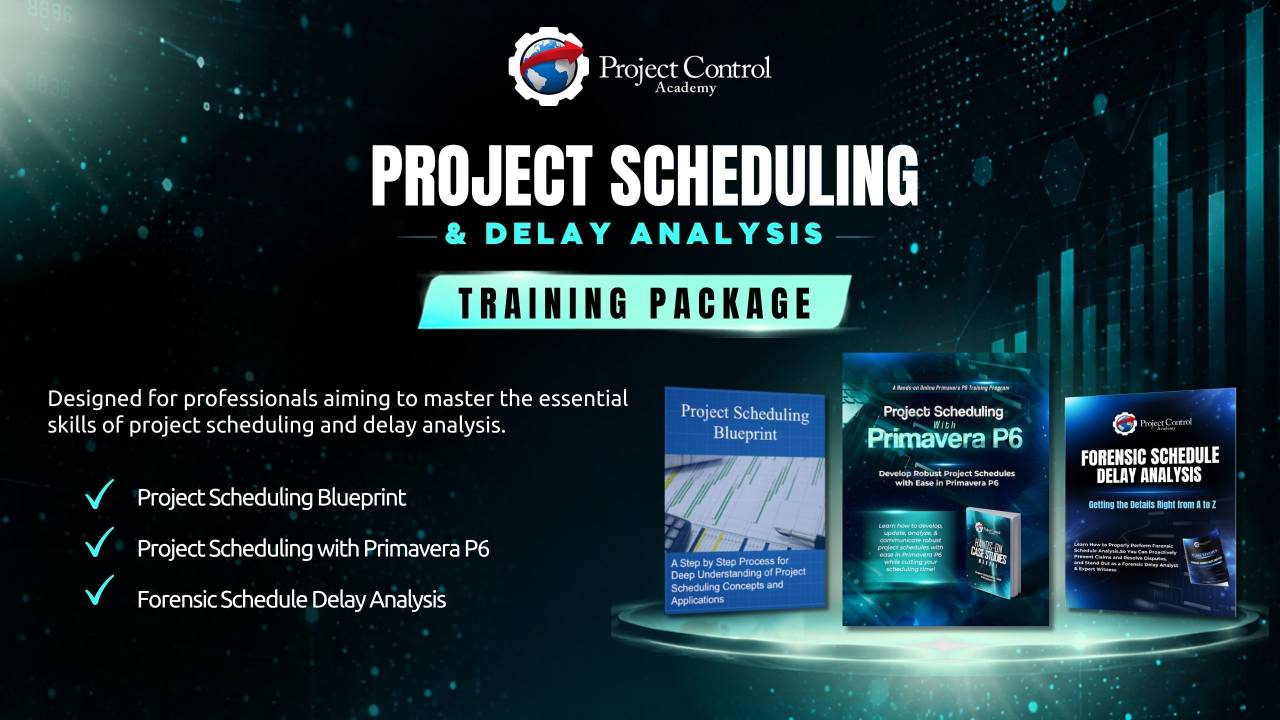
The Project Scheduling & Delay Analysis Training Package gives you a structured path to build stronger scheduling capability—from understanding the principles behind a credible schedule to applying them in Primavera P6 and analyzing delays when projects do not go according to plan.
Instead of trying to piece together scheduling knowledge from software training, on-the-job experience, disconnected courses, and delay-analysis techniques, this package gives you one logical progression.
You begin by building a strong foundation in project planning and scheduling principles, including CPM, logic, float, resource loading, baselining, updating, and schedule analysis.
Then you put those principles into practice using Primavera P6, developing the hands-on skills to build, maintain, update, analyze, and communicate project schedules more effectively.
Finally, you take your scheduling capability to a more advanced level by learning how project delays are investigated, how forensic delay-analysis methodologies are applied, and how causation, concurrency, mitigation, and responsibility are evaluated when delays lead to claims or disputes.
Project Scheduling Blueprint
A scheduling tool can calculate dates.
It cannot tell you whether the schedule was built properly.
That distinction matters.
One of the biggest misconceptions in project planning is that learning Primavera P6 or Microsoft Project automatically makes someone a strong scheduler.
Software is important, but the real capability comes from understanding scheduling principles.
The Project Scheduling Blueprint gives you a step-by-step understanding of how credible project schedules are developed, analyzed, maintained, and communicated.
The program includes 19 in-depth modules covering the complete scheduling process—from defining activities and relationships through CPM, resource loading, schedule health, acceleration, updating, variance analysis, and reporting.
It helps you understand what is happening behind the software so you can make better scheduling decisions, recognize weak schedule logic, and build schedules that are not only technically correct, but useful for managing the project.
Explore full details about Project Scheduling Blueprint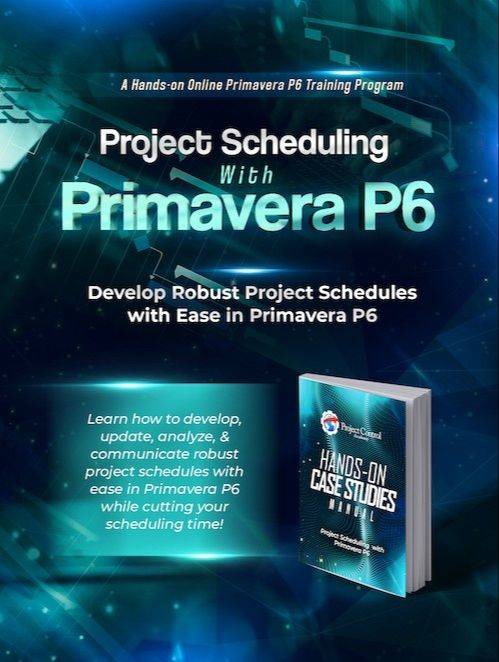
Project Scheduling with Primavera P6
Understanding scheduling principles is essential.
But at some point, you need to put those principles into practice.
The Project Scheduling with Primavera P6 training helps you do exactly that.
This hands-on program shows you how to take sound scheduling concepts and apply them inside one of the most widely used professional scheduling platforms in the world.
You will learn how to build project schedules from the ground up, create WBS structures and activity logic, assign resources, establish baselines, update progress, analyze the critical and longest paths, evaluate schedule health, and communicate schedule performance more effectively.
The program goes beyond basic software navigation. It focuses on using Primavera P6 efficiently and intelligently—so you understand not just where to click, but why you are doing it and what the results mean.
Through practical exercises and project case studies, you develop the confidence to work with real schedules, troubleshoot common issues, and spend less time on routine schedule maintenance and more time on meaningful analysis.
Explore full details about Project Scheduling with P6
Forensic Schedule Delay Analysis
Building and updating a schedule is one level of capability.
Understanding what happened when a project became delayed is another.
When a project finishes late, simply comparing the planned and actual completion dates is rarely enough.
You need to understand what caused the delay, when it occurred, whether it affected the critical path, whether other delays were happening at the same time, and how responsibility should be evaluated.
The Forensic Schedule Delay Analysis training takes your scheduling knowledge to that more advanced level.
This program helps you understand how project schedules and contemporaneous records are examined when delays lead to extension-of-time requests, claims, negotiations, or disputes.
You will explore recognized forensic delay-analysis methodologies and learn how concepts such as causation, concurrency, pacing, mitigation, acceleration, float ownership, and schedule validation are evaluated in practice.
The focus is not simply on learning the names of different methodologies. It is on understanding when and why they are used, what assumptions they rely on, and how to select an approach that fits the available project records and circumstances.
Explore details about Forensic Delay Analysis
Three Courses. One Connected Project Controls Journey.
Each of these programs delivers valuable knowledge on its own.
But when you complete them together, you develop a much more complete understanding of project scheduling and delay analysis.
You begin with the principles behind a credible schedule.
You learn how activities, logic, durations, float, resources, baselines, and critical paths work together.
Then you take those principles into Primavera P6 and apply them in practice—building, updating, analyzing, and communicating project schedules more effectively.
From there, you move into a more advanced level of capability: understanding what happens when delays occur, how schedules are examined retrospectively, how causation and concurrency are evaluated, and how different forensic methodologies are applied.
You begin to see the full picture.
Not simply how to build a schedule.
Not simply how to use scheduling software.
But how a schedule evolves over time—and how that schedule can later become critical evidence when a project is delayed.
That is when scheduling becomes more than a technical task.
It becomes a powerful tool for planning, controlling, analyzing, and explaining project performance.
Scheduling Is a Connected Discipline.
A strong scheduler needs more than software knowledge. They need to understand CPM, logic, float, baselines, updates, resources, and critical-path behavior. A Primavera P6 user becomes far more effective when they understand the scheduling principles behind the software. And a delay analyst cannot credibly evaluate causation, concurrency, or responsibility without first understanding how the schedule was developed and maintained. That is why we built this package. Instead of learning scheduling theory, Primavera P6, and forensic delay analysis as separate subjects, you have the opportunity to develop one connected body of knowledge—from building the schedule, to managing it, to analyzing what happened when the project was delayed.
How Does It Work?
All three courses under this training package are delivered online. As soon as you enroll, you’ll get access to the first week of training for each course included in the training package and can start immediately.
To access the training package, all you need is a high-speed Internet connection via Google Chrome, Safari, or Internet Explorer 9 or newer. You also need a login ID & Passcode to our private and secure learning management system (LMS), which is provided via email once you enroll.
The LMS platform we use is accessible via desktop computer, laptop, as well as mobile devices such as iPhone, iPad, Tablets, etc.
You can either follow the program according to the weekly content and finish each course within 5 to 8 weeks on average. You’ll have access to the training package material for one year after your enrollment. You can refer to the training videos and material at any time.
You'll also have access to the instructor via the course LMS for one year to get guidance and support and answer your questions.
We won’t leave you alone in your learning journey with us and will be there to support you during your one-year access and beyond.
What You Will Be Able to Do
By completing the Fundamentals of Project Controls Training Package, you will develop a much broader understanding of project controls and how its major components work together.
You will be better equipped to:
PLAN: Understand how scope, activities, logic, durations, resources, budgets, and baselines come together during project planning.
SCHEDULE: Develop and analyze schedules using sound CPM principles rather than relying solely on software.
MEASURE: Understand how project progress and performance should be measured against an approved baseline.
ANALYZE: Interpret cost and schedule variances, trends, performance indicators, and schedule conditions.
FORECAST: Use current project information to develop more informed expectations about future project performance.
COMMUNICATE: Translate project controls information into insights that project managers, teams, and stakeholders can understand and act upon.
GROW: Develop a clearer understanding of project controls career paths and identify the knowledge, skills, and credentials that may help you advance.
Who Is This Training Package For?
This program can be particularly valuable if you see yourself in any of the following situations.
“I Want to Start a Career in Project Controls.”
Perfect.
The package gives you a structured foundation so you do not have to figure out where to begin or try to piece everything together yourself.
“I Already Work in Project Controls, But Most of What I Know Was Learned on the Job.”
This is extremely common.
Your practical experience is valuable. The training helps you put structure around that experience, strengthen areas where you may have gaps, and better understand the principles behind the work you already perform.
“I Am a Planner or Scheduler and Want Broader Project Controls Knowledge.”
You may understand scheduling well but want greater exposure to cost control, EVM, performance measurement, forecasting, and the larger project controls process.
This package helps expand that perspective.
“I Work in Cost Control and Want to Understand Scheduling Better.”
Cost and schedule performance are closely connected.
Understanding the schedule, CPM, progress measurement, baselines, and EVM can help you interpret project performance more comprehensively.
“I Am a Project Manager and Want Better Visibility and Control.”
Project managers rely heavily on controls information.
Understanding how that information is created and interpreted can help you ask better questions, identify warning signs earlier, and make more informed project decisions.
“I Want to Prepare for Greater Responsibility.”
If your goal is eventually to become a senior project controls professional, lead, manager, or project manager, developing broader capability across the project controls disciplines can give you a much stronger foundation.
“I Am Preparing for a Professional Certification.”
These courses can also strengthen your understanding of concepts relevant to professional development and certifications across project management and project controls. The Applied Project Controls course specifically identifies certifications such as PMP, PMI-SP, PSP, EVP, and CCP as areas where stronger project-controls knowledge can be helpful.
You Do NOT Need to Be an Expert to Begin
One of the strengths of this package is that you can start with the fundamentals and progress from there.
The Applied Project Controls program is designed for people new to project controls as well as those strengthening an existing foundation. The EVM Mastery program has no specific EVM prerequisite, and the Project Scheduling Blueprint focuses on scheduling principles rather than requiring expertise in a particular scheduling application.
You do not need to know everything before you begin.
That is the point of the journey.
Are There Any Pre-Requisites to This Training?
One of the strengths of this package is that you can start with the fundamentals and progress from there.
The Applied Project Controls program is designed for people new to project controls as well as those strengthening an existing foundation. The EVM Mastery program has no specific EVM prerequisite, and the Project Scheduling Blueprint focuses on scheduling principles rather than requiring expertise in a particular scheduling application.
You do not need to know everything before you begin.
That is the point of the journey.
This Training Package Comes with Awesome Benefits and Bonuses that You Cannot Miss!

24/7 Access for 12 Months
You are busy. We understand. That is why you have access to the course materials for a full year. Learn at the pace that works for you. Revisit important concepts. Return to specific modules when you encounter similar situations at work.

Official Certificates of Completion and PDUs
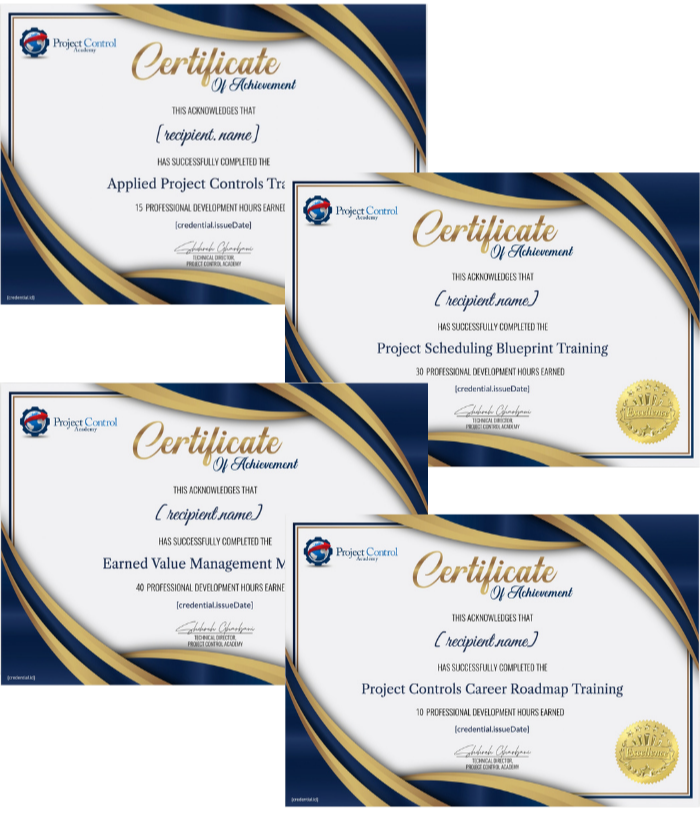
Receive 4 official certificates of completion upon successful completion of the training package and claim 95 Professional Development Units (PDUs) earned toward maintaining your license(s) with professional associations.

Course Material & Supportive Documents
Where included within the individual programs, you will receive supporting course materials and downloadable resources that you can refer to during and after the training.

Quizzes and Case Studies
The programs are designed around application, not simply watching videos. Exercises, examples, case studies, and quizzes help you reinforce concepts and understand how they apply in project environments.

Private and Secure
Get access to all the training materials on our secure and robust learning management system using your private username and password.

Mobile Friendly
Get access to the training via computer, laptop, as well as mobile devices such as iPhone, iPad, Tablets, etc. This makes your learning more flexible & adaptable.

Access To "Ask The Instructor Forum" (Value: PRICELESS)
Learning should not stop when the video ends. The courses provide access to instructor support for 1 year, so you can ask questions and receive guidance while working through the material.
Special Alumni Discounts (Value: Up to $600)
Receive exclusive discounts ($150 to $300) on future online training programs with Project Control Academy upon the successful completion of each course of this package package.
What Could Stronger Project Controls Capability Mean for You?
The Fundamentals f Project Controls Training Package can help you become more confident in your current role, better understand the project information in front of you, and contribute more meaningfully during project reviews and decision-making.
It can strengthen your scheduling knowledge, deepen your understanding of EVM and project performance, and help you take on broader responsibilities within project controls.
It can also give you the foundation to pursue new opportunities whether that means moving into planning and scheduling, expanding into a more senior project controls role, or preparing yourself for the next step in your career.
No training can guarantee a promotion or a new job title.
But you can strengthen your capabilities. You can close knowledge gaps. You can become better prepared for greater responsibility.
And when the next opportunity comes, you can be ready for it.
A Complete Project Controls Education at a Significant Saving
When you enroll today, you will receive 12 months of access to the complete Fundamentals of Project Controls Training Package, including all four comprehensive courses, supporting resources, instructor guidance, practical exercises, and the additional benefits included within each program.
You are not simply gaining access to individual courses. You are investing in a structured learning path designed to help you understand how the major areas of project controls work together—from planning and scheduling to cost control, Earned Value Management, performance analysis, forecasting, and career development.
If you were to enroll in each course separately, your total investment would be $4,287.
Your investment:
Only $4,287 $3,297
for full access to the complete training package and its benefits & bonuses
You Save $990
Projects need professionals who understand more than one isolated piece of project controls.
They need people who can see the bigger picture.
People who understand how scope, schedule, cost, progress, performance measurement, and forecasting connect—and who can turn that information into better project decisions.
That broader capability is what this package is designed to help you build.
Whether you are entering project controls, strengthening skills you have learned on the job, preparing for greater responsibility, or expanding your knowledge beyond your current specialty, this training gives you a structured path to develop a stronger and more complete foundation.
The knowledge you gain can help you contribute with greater confidence, understand project information more clearly, communicate more effectively with project teams, and prepare yourself for the next stage of your professional growth.
This is more than an investment in four courses.
It is an investment in your capability as a project controls professional.
And the stronger your capability becomes, the more value you can bring to your projects, your organization, and your career.
Fundamentals of Project Controls
Online Training Package
✔ 4 Online training programs (Applied Project Controls, Project Scheduling Blueprint, Earned Value management Mastery, and Project Controls Career Success Roadmap) in one comprehensive training package
✔ 12 months of access to the instructor
✔ 24/7 access to the training material for 12 months
✔ 4 Certificates of Completion
✔ Up to 95 PDUs
✔ Exercises, case studies, quizzes, and supporting resources
✔ The flexibility to develop your skills at your own pace in a private LMS
One Payment Option
One Payment of $4287 $3297 USD
Save $990 Off the Regular Fee
Get the Complete Training Package >>3-Payment Option
3 Payments of $1500 $1150 USD Each
1st Payment Today
Get the Complete Training Package >>
YOU CANNOT GO WRONG WITH THIS INCREDIBLE GUARANTEE
We want you to feel confident about your decision to enroll. That is why Project Control Academy provides a 15-day satisfaction guarantee on its training programs. Explore the training package Experience the quality of the instructions. Begin working through the material. If you determine during the applicable guarantee period that the training is not right for you, you may request a refund in accordance with the program's refund terms in our Terms and Conditions page. Your learning should feel like an investment, not a gamble.
Learn From a Project Controls Practitioner Who Understands the Real Challenges

Shohreh Ghorbani
Founder & Technical Director, Project Control Academy
Project controls is not something Shohreh teaches only from textbooks.
Her training reflects years of practical experience in project controls and a deep commitment to helping project professionals understand not only what to do, but why they are doing it.
As Founder and Technical Director of Project Control Academy, Shohreh has helped professionals around the world strengthen their knowledge and capabilities in project controls.
Her teaching approach is practical, structured, and focused on making complex concepts easier to understand and apply.
Across these programs, she guides you from foundational concepts into increasingly practical applications in scheduling, EVM, performance analysis, and project controls..